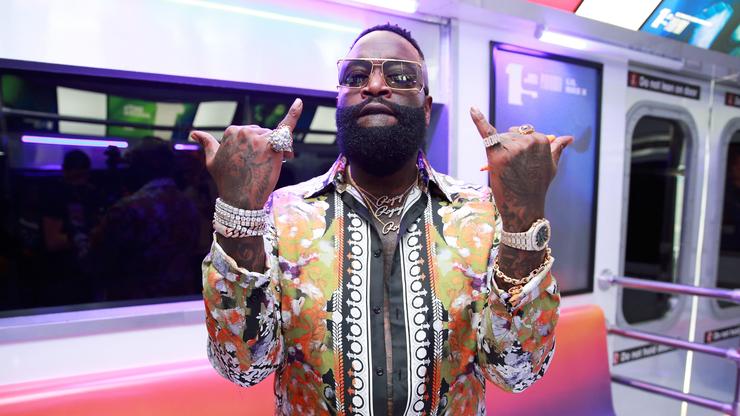
We’re approaching one of the most important evenings in music this month — the 62nd annual Grammy Awards. I mean, at this point, it’s hard to really allow the Grammys to hold any weight when it comes to an informed opinion on hip-hop but, the world continues to turn and the Grammys maintains its position as a coveted musical institute. Rick Ross is among the nominees in one of the hip-hop categories. His song, “Gold Roses” ft. Drake is nominated for Best Rap Song.
Rozay’s been nominated for six Grammys at this point with “Gold Roses” marking his second nomination alongside Drake. The two rappers have quite the working history together and have proven to have incredible chemistry on wax time and time again. Ahead of the award show, Rick Ross shared a statement thanking Drake and sharing the connection “Gold Roses” has to Nipsey Hussle.
“Being nominated for ‘Gold Roses’ [as Best Rap Song] means a lot to me. It was born from a real conversation Drake and I were having after Nipsey’s untimely passing. So to be recognized for it feels like we’re being given our ‘Gold Roses’ while we’re still here,” he said.
He elaborated further in the caption, writing “I Thank @champagnepapi for Being an incredible artist and more importantly remaining a stand up guy. I thank @recordingacademy#Grammys for acknowledging #GoldRoses I look forward to an incredible night to remember.”
 Gregg DeGuire/Getty Images
Big Sean Reveals Deadline For His New Album After Coachella Announcement
Big Sean teases a full-length release for April.
With only a few singles released in the last twelve months, 2019 can be considered somewhat of an off-year for Detroit rapper Big Sean. The recording artist had been working on himself, getting his anxiety under control before marking a return to music. Sean had previously delayed his tour the year prior, also pushing back his album release so that he can truly get back to his regular self. Now, it would appear as though he’s back and ready to rumble. The full line-up was announced last night for Coachella 2020, with headliners Frank Ocean, Travis Scott and Rage Against The Machine stealing the show. Further down the list of performers is Big Sean, and he’s poised to show the crowd some brand new music.
Reacting to his placement on the festival’s highly-anticipated line-up, Big Sean teased the arrival of his new full-length project before he hits the stage in April. “Guess I got a good deadline for the new album now?” asked the superstar on social media, hinting that it could arrive anytime within the next four months. It’s been such a long time since we heard Big Sean in his element so a new album will definitely be a breath of fresh air for his fans, who have been waiting for years.
Are you looking forward to this?
Juice WRLD & Yellowcard’s "Lucid Dreams" Legal Battle Explained & Debunked
INTERVIEW: We talk with Jeff Peretz about a few recent legal cases in the music industry, including that of Juice WRLD and Yellowcard.
In October of 2019, rock band Yellowcard took things to the next level in their claim against Juice WRLD. Upon hearing the massive hit that was “Lucid Dreams,” the band noted similar melodic elements to their song “Holly Wood Died.” To address and rectify the issue of alleged copyright infringement, Yellowcard sent out a notice to Juice WRLD’s team, publisher, and record label. However a lack of response left the band “no real choice” but to file an official complaint. Although both tracks sample Sting’s “Shape of My Heart,” Yellowcard is claiming that the pitch and note composition of each song’s first verse is a blatant copy of one another. But they didn’t just stop there. In addition to the melodies chosen, Yellowcard is also claiming the song similarities come from an emo influence they left behind in the mid 2000s when Juice WRLD was growing up. And this is where things have gotten tricky.
According to Yellowcard, prior to his death, Juice WRLD admitted in previous interviews that he fell in love with emo music as a kid. Juice WRLD cited influences from Fall Out Boy and Foo Fighters. And because of so, Yellowcard is claiming that Juice WRLD would have came across “Holly Wood Died” when he began studying the genre. Whether Juice WRLD was subconsciously influenced by the band, or intended on making something reminiscent of it, the court will now look at whether or not the average person can be convinced that the two songs are the same. Two songs being similar enough to fool someone into accidentally picking one, instead of the other, is a valid idea. But suing due to influence is a rather new play in the endless existence of these copyright cases.
A Juice WRLD tribute mural displayed at Rolling Loud LA, December, 2019 – Scott Dudelson/Getty Images
Throughout the entire history of sound, every artist has been influenced by someone, and every song has leaned on those influences in some way. So in reality, Yellowcard’s claim of influence shouldn’t hold much merit. But if it does, this case will be yet another recent example, in addition to the “Blurred Lines” case, of how convoluted copyright infringement cases have become from the fact that courts can’t distinguish between stealing someone’s work and being influenced by it. “There’s no such thing as originality in music. Everyday ideas come from previous ideas,” musicologist Jeff Peretz says. “There’s a difference between homage and theft. And that’s the fine line that everybody needs to try and get their head around.”
As he’s often called on to compare sheet music in copyright infringement cases, Jeff Peretz has identified the lack of experts and improperly decided cases as the main reason why artists feel comfortable suing for such things. It’s unclear whether Yellowcard or Juice WRLD’s estate will emerge victorious in this case. But in the meantime, we talked Jeff Peretz about the details of the lawsuit as part of a larger piece that fully explains the ins and outs of copyright infringement cases within the context of the music industry. We’re following that up with even more insight, by giving our readers some of the Q&A that transpired with Peretz.
This interview has been edited down for clarity and length.
HNHH: How do you think the “Blurred Lines” case has changed the music industry?
Jeff Peretz: That’s a good question. And I had a lively discussion with one of my closest friends, Peter Rosenthal of the in-house counsel for Downtown Music Publishing, and he thinks it’s just a blimp on the radar. And I think that it’s a precedent setting, and definitely ramped up people when it comes to running to their lawyers. In past times, people would’ve been like, “Oh that’s cool. You leaned on some of the things we’ve leaned on.” Think about the blues. The chord progressions in the blues is the same. Every blues song has the same structure, and imagine if the first person copy-wrote that structure and that chord progression. Nobody else would be able to make the blues ever again. And so, we can’t limit these kind of things. I don’t know if the “Blurred Lines” case changed the music industry, it just made people a little bit more trigger happy when it comes to claiming theft. And because they’re looking for an easy payout. I don’t know that it actually affected the way that these things get adjudicated because before “Blurred Lines,” you could’ve convince somebody of anything and after “Blurred Lines,” you could convince somebody of anything. I think after “Blurred Lines,” you’re just starting to see more people try.
These cases are typically expensive. Do you have any idea as to how much copyright cases are to pursue?
It depends on how far it gets. I’d be shooting in the dark by throwing numbers at you, but many of them are brought with the hopes of a quick settlement to keep the profile down and to keep the reputation in tact to not be considered a thief. I would imagine that the amount of money spent on the “Blurred Lines” case would probably be hundreds and thousands of dollars right now, maybe even more. Whereas a quick cease and desist, threatening a lawsuit can be settled pretty quickly and the amount of money will change. Usually what happens though when the cases are settled, is that they’re settled by the person who is being sued, adding the person who’s making the claim, to the copyright so that they get some of the profits moving forward. Whereas in the “Blurred Lines” case, they were given like $7 million dollars in damages too, which was reduced and then added to the copyright moving forward so any future revenue is split. People are even preemptively doing this now. Think about the song “Panini” by Lil Nas X. That little melody comes from a Nirvana song (“In Bloom”), those three notes. They could’ve probably have gotten away with that, but they didn’t even wanna take a chance, so Kurt Cobain was a co-writer on the song before it was even released. They were like, “I don’t want to have any fucking trouble, so just put him on.” I don’t know what the split was but they were like, “I don’t want any trouble whatsoever, so we’re just going to give him a percentage of this song.” If you open Spotify right now and open the songwriting credits, it’s Lil Nas X, it’s Denzel and Dave Borough from Take A Daytrip, and its Kurt Cobain, as if they collaborated in a room. Kurt Cobain has been dead for how many years? But he’s still writing great songs apparently.
This typically seems to happen once a song blows up. Juice WRLD’s “Lucid Dream” got huge, and then Yellowcard decided to sue him. Say that there’s an underground artist as opposed to someone who’s number one on the charts. Are there any requirements surrounding the popularity of an artist?
I would imagine. Half of nothing is nothing. Suing somebody over a song that hasn’t done anything or gone anywhere or made any money, is just kind of senseless. So yeah, and the higher the profile of the song, the more streaming and money it generates. More people come out of the woodwork looking for a piece of that pie. With Lil Nas X, it’s interesting to think like, he had the number one song for however many weeks he was up there. So it almost goes without saying that whatever he dropped next, was going to get some play, right? So I would imagine the legal team that was involved with the writer splits on “Panini” was like, “There’s no way this song is going to go under the radar. So if somebody can make the claim, that it sounds like Nirvana, we need to get ahead of that.” Whereas if that song was written by two unknown artists in some unknown place and it came out and had to try to compete on the charts with its own merit, without the previous song of that artist being a number one hit, I don’t know that it would’ve been handled the same way. I would imagine that they would be less concerned about adding Kurt Cobain as a copyright if it were just an unknown artist who was just trying to make their way out there. To me, one of the coolest things about that song is that it’s familiar. Rhythmically, there are more syllables than the Kurt Cobain song, so there’s no rule that says three notes is good and four notes is bad. But could I walk into a record store and say there’s a song I want to hear and sing that rhythm, and they sell me “Panini” when I’m really trying to buy “In Bloom”? Could I be fooled into thinking I was buying the wrong thing? So apparently, the legal team for Lil Nas X and Take A Daytrip thought it could, so they got out ahead of it and did the copyright. Which as far as the story goes, makes them cool because it makes them fair and understand and be honest. It makes them better than thieves. They borrowed that little piece that fit great into their collage, but they paid for it. That’s kind of like standup behavior. Whether or not it would’ve been or could’ve been the grounds for a copyright infringement sue remains to be seen because they preempted that. But for other people in certain circumstances, it could’ve been those three notes. It heightened the awareness of that kind of stuff.
Considering how most people don’t try to attack until the song gets big, is there a time frame in which people can sue?
No! “Got to Give It Up” came out in 1977 and it was a number one hit. So no, there are no statute of limitations on it. I just worked on a case for Bob Geldof from the Boomtown Rats on his song “I Don’t Like Mondays.” That song was written in the early ’70s and the piano player is now claiming that he wrote the main riff. They settled that at court in the U.K. The laws are a little bit different there, but it’s the same thing. It begs the question, where fuck have you been for 30 years? Now all of a sudden you’re saying you wrote this, but why now? But “Blurred Lines” came out in different circumstances. It came out when it came out but it leaned on these tropes from the song which came out in ’77. So there can’t really be any kind of time limit. Technically, here’s where the time limit comes in; for copyright, you own your song until 75 years after the death of the composer, that’s when the copyright goes into public domain. So that’s the time limit. If I want to literally, re-record “Shoop” by Salt-N-Pepa, I have to wait until all of the writers have died. And from the last writer on that song, I have to wait 75 more years and I can literally re-record it note for note and reclaim it as my own. But by that point, it’s like a “Happy Birthday.” It’s part of the fabric of the culture. No one really owns that anymore.
So in Juice WRLD’s case, one of the newest claims is that Juice WRLD would have been subconsciously influenced by Yellowcard’s music. And he would have heard “Holly Wood Died” growing up. Is that a valid defense in these kinds of cases?
It doesn’t matter if he’s heard it. I have a feeling that what they’re arguing is going to be based off of the chord progression, which is not copyrightable and I can debunk it right now. That’s the whole precedence that was set with the George Harrison case. It doesn’t matter if they’ve had access to hearing it or not. It’s if there are similarities in the melodic arch, and the notes that they’ve chosen on each chord are the same note. “Lucid Dreams” has many more syllables happening in it, so it’s not going to look the same. But to your first question, it doesn’t matter if they’ve had access to it. They could’ve never heard it in their lives. It sounds like it’s similar enough, but they would either have to settle or they can be found guilty of infringement.
In copyright cases, there’s a lurking idea of “subconsciously plagiarizing.” We talked about influence earlier, but every artist might not realize that they’re utilizing a previous influence. How would someone defend that claim in the court?
You don’t, it doesn’t matter. Because the intention has nothing to do with it. When you set out to do it, you did it willingly. Or you had no idea or it came to you in a dream or you grew up with a bathroom and you’ve never heard any other music in your life and the first song you wrote turned out to be “I Want To Hold Your Hand” by The Beatles, coincidentally… it doesn’t matter. But does it line up? So yeah, sometimes that’s probably the way it happens more often than not. Your instincts guide you to something you’ve heard before.The way that human beings appreciate and fuck with music, is that when you go to a show, you want to hear something familiar and see something you’ve never seen before. Those are the golden rules of putting on a great show. People want to go and jump up and down, and sing along. They want to have their mind blown by the theatrics on the stage, not the opposite. They don’t want to hear something new for the first time in a show and then see something they’ve seen everyday of their lives. They want to hear something familiar and see something they’ve never seen. So when we’re creating, our instincts rely on something we’ve heard before and that’s the way that we develop what it is that we’re doing. Then it’s how far away we can get from our influences that determine when people people consider us to be innovative. Innovators assimilate their influences and make something that gets further away from them.
I was reading your piece on Vulture, and I saw that T.I. got off the hook because he wasn’t a major figure in the creation of “Blurred Lines.” He just came in and did his thing. Who’s typically held accountable in these situations?
The songwriters. T.I.’s contribution was that he spit a verse on an already created piece of music. I don’t know that there’s a hard and pressed rule about this, but in that particular case, that’s the way it was looked at. They had this song, it sounded like “Blurred Lines,” and whether T.I. came in or not, it didn’t change anything about how it all kind of went down. He is on the copyright, because of the words that he wrote and put on top of the beat which could’ve been any beat. So he was kind of let off the hook in that respect. I think rightfully so, he had nothing to do with the argument that this song sounds like the other song. Robin Thicke was saying “Oooohhh!” left and right, which is a big trope of Marvin Gaye’s. He was using that, but no one can own that. Yes, it’s going to remind you of this other song, but its not against the law. T.I.’s part of that was that he was just a guest rapper who spit a verse on top of the already predetermined beat. And whatever the beat was, it would’ve been the same verse.
And my last question is, I remember you saying that these kinds of cases can limit creativity and stifle innovation. If it’s starting to become such a sensitive thing, how can artists navigate without crossing any legal boundaries? Are there any solutions?
We teach a class at the Clive Davis Institute called recycling pop music, which is just about that. And it studies all the way back to classical music, going back hundreds of years with great composers like Bartok who would go and take the folk melodies that they heard in villages in Austria and Hungary, and then co-op them and turn them into these grand classical music pieces. So the idea of recycling and copying is like fundamental to the creation of music. So knowing when you are conceptually borrowing when you’re borrowing for style, and when you are literally using the idea of another individual. Once again, those lines are blurred but there’s really no short answer for that. Its a lifetime of work to understand when you are…And it also comes with the intention. If I’m intending to fool you, thinking I wrote something that I know that I didn’t write, then that’s plagiarizing. If I accidentally come across the same thing, it’s tried out, and then it’s decided that it’s the same thing, then shame on me and I write a check and we move on. If I love Radiohead and write some of the same chords or some of the same drum patterns or tempos, or I sing falsetto and I’m developing my own thing and using some of the same colors that they use, no artist can copyright blue. But if I want to paint like Picasso’s blue period, I’m going to use a lot of blue, right? So if you’re using it to develop and come up with your own thing, it’s one thing. If you’re actively trying to fool somebody, it’s another. But that is the job of an artist. You can ask a thousand artists, and they’ll tell you that they want to be original. Good luck, because there’s no such thing. But it’s about how much distance you can get from your influences. If you think about Oasis, it’s two clicks away from The Beatles. And so, people find them derivative and some people love them for that, and some people hate them for that. But they don’t steal the actual notes, beats, and chords from The Beatles. They just sound a lot like them and they have the same haircuts and shit. You take something like the Wu-Tang Clan. They’re 10 clicks away from the Sugar Hill gang, even though they’re both using instrumental beats that came from songs before them. And they’re putting words on top of them in rhythm. So it’s how far away from your influences can you get. No one would ever look at the Wu-Tang Clan as trying to be Sugar Hill Gang. Whereas people would look at Oasis as if they’re trying to be The Beatles. So it’s how far enough can you get, that determines how “innovative or original”? But the reality is, they’re relying on the same techniques and the same tropes.
'Justin Bieber: Seasons' Docuseries Coming This Month [OFFICIAL TRAILER]
Justin Bieber is gearing up for his 2020 comeback — and now we have the inside scoop on his 10-part documentary series coming soon.
Justin Bieber: Seasons will premiere YouTube Originals on January 27 and stream weekly. The new docuseries shows the pop star at his best, as well as his worst. Ultimately, Justin opens up to reveal his biggest challenges as he gets back into the studio to record his first album since 2015.
With an all-new album and full-on tour, Bieber is showing us a side we’ve never seen before. Plus, he’s exposing his life behind-the-scenes through this brand new docuseries based around the forthcoming album and his current state.
Bieber previously worked with Jack Ü, DJ Snake, David Guetta, DJ Khaled and many more, racking up billions of plays in the process. Now, he’s readying to release his first solo music since Purpose.
Watch the official trailer below.
Justin Bieber: Seasons (Official Trailer)